
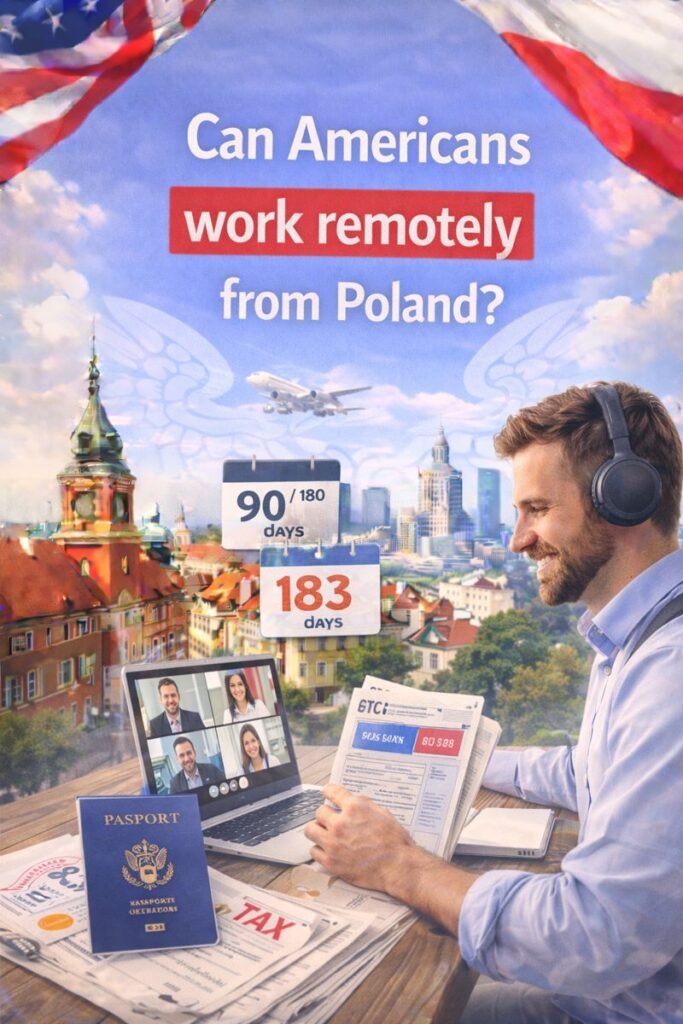
Can Americans work remotely from Poland? Yes — but “remote work” doesn’t automatically give you the right to live in Poland long-term. For short stays, many Americans visit Poland under Schengen rules (up to 90 days in any 180-day period). For anything longer, you typically need a visa or residence permit that matches your purpose of stay — and you should plan for tax residency if you live in Poland most of the year.
Poland is popular with Americans because it’s affordable, well connected (especially cities like Warsaw and Kraków), and easy to enter short-term — but the “legal” part depends on how long you stay and what you’re doing while there.
(Informational only — not legal advice.)
Short Answer
Yes, Americans can work remotely from Poland — but it depends on your length of stay and immigration status.
- Up to 90 days (short-term): You can generally enter Poland visa-free under Schengen rules (90/180). That covers travel and typical “business visitor” activities, but it doesn’t automatically authorize long-term living or local employment.
- Over 90 days (long-term): You usually need a national visa (D) or a temporary residence permit tied to a lawful purpose (work, business, study, family, etc.).
- If you work for a Polish employer: Poland has clear routes like a temporary residence and work permit.
Important nuance: Poland does not widely market a dedicated “digital nomad visa” like some European countries do. A Europe-wide list updated on January 10, 2026 highlights many countries with specific remote-work visas — Poland is not among them, so remote workers usually rely on other legal bases (work/business/study/family), depending on the facts.
Legal & Practical Requirements
1) Your stay is limited to Schengen 90/180 without a visa
The U.S. Department of State explains that U.S. passport holders can stay in the Schengen area up to 90 days in any 180-day period for tourism or business travel.
If you want to stay longer, you need a longer-stay permission (visa D or residence permit route).
2) “Remote work” is real work — and Poland has work/residence frameworks
Poland’s immigration framework focuses on legal right to stay and, when applicable, permission to work. The Office for Foreigners (Poland) portal provides official guidance and tools for residence procedures, including temporary residence permits and work-related permits.
For people working for a Polish employer, the “temporary residence and work permit” is the standard route.
For entrepreneurs, there’s also a temporary residence permit for conducting business activity.
3) You must plan for taxes if you live in Poland most of the year
Poland’s Ministry of Finance guidance says you become a Polish tax resident if you:
- have your centre of personal or economic interests in Poland, or
- spend more than 183 days in Poland in a fiscal year.
If you become tax resident, Poland generally expects reporting of income accordingly (and double tax treaties matter).
4) Social security is separate from income tax
Even if you manage income tax correctly, remote work can create a “double contributions” risk (U.S. vs Poland). The Social Security Administration explains the U.S.–Poland Totalization Agreement and the use of certificates of coverage to avoid dual social security taxation in some scenarios.
Step-by-Step: How Americans can work remotely from Poland
Step 1: Decide if this is a short stay (≤ 90 days) or a long stay (> 90 days)
- Short stay: You’re in the Schengen “90/180” bucket.
- Long stay: You need a plan for a legal right to stay beyond 90 days (usually visa D or temporary residence).
Step 2: Pick the best legal pathway for your situation
Here are the most common “real-world” paths Americans use when they want to live in Poland and keep working remotely:
- Polish employer route (job in Poland)
- Use the “temporary residence and work permit” framework (work + residence combined).
- Business / entrepreneur route (B2B, company, self-employment)
- If you plan to conduct business activity in Poland, the Office for Foreigners portal provides guidance for a temporary residence permit for conducting business activity.
- Study route
- Often used when someone wants a lawful long stay and structured status (and then continues remote income separately). (Specific details vary by school/program and permit type.)
- Family route
- If you have family ties that support residence, it can be simpler than work-based paths.
Reality check: Because Poland isn’t broadly listed among Europe’s countries with a dedicated “digital nomad visa,” most Americans use one of the above routes rather than a “nomad visa” label.
Step 3: If you need a long-stay visa, understand “Type D” basics
Poland’s government pages for visa information describe national visas (D-type) as the category used when you need to stay longer than 90 days and require specific documentation such as insurance (exact checklists vary by consulate).
Step 4: Build a compliance “stack” for remote work
Even if you keep a U.S. employer/client, living in Poland long-term can trigger practical obligations:
- Tax residency tracking: Count days and track your “centre of interests.”
- Proof of income: Landlords, banks, and immigration processes often require clear financial evidence.
- Health insurance: Often required for visas/residence filings (varies by path).
- Social security planning: If your situation involves cross-border employment/self-employment, learn how the totalization agreement and certificates of coverage work.
Step 5: Use the official portals for residence procedures
Poland’s government has promoted the MOS portal for residence permit processes and document preparation to reduce mistakes.
(Processes and “digital-only” filing rules can change; always follow the current official instructions.)
Costs & Fees (What Americans Usually Pay)
Your biggest costs are usually not “remote work fees.” They’re the practical costs of staying legal, reducing risk, and avoiding expensive mistakes:
1) Immigration & documentation costs
- Visa/residence application fees (vary by route)
- Translations, certified copies, apostilles (case-by-case)
- Health insurance coverage evidence (often required for long-stay documentation)
2) Tax & accounting support
If you’re in Poland long enough to become tax resident (183+ days or centre of interests), Americans often pay for:
- an accountant familiar with cross-border income
- help understanding what income must be reported and how to avoid double taxation (treaties matter)
3) Banking & currency conversion
- exchange spreads
- international transfer fees
- card fees if you keep U.S. banking
Common Problems & Mistakes Americans Make
Mistake 1: “I’m just on my laptop, so it doesn’t count as work”
Immigration systems often focus on activity and presence. If you’re effectively living in Poland, you need a lawful basis to stay beyond 90 days.
Mistake 2: Overstaying Schengen 90/180
This is the most common and most avoidable mistake. The U.S. Department of State is clear about the 90/180 rule and the need to wait before re-entering if you’ve used your days.
Mistake 3: Becoming a Polish tax resident “by accident”
Poland’s own guidance says 183+ days or “centre of vital interests” can make you tax resident.
Remote workers sometimes ignore this until filing season.
Mistake 4: Ignoring social security exposure
Income tax isn’t the whole story. The Totalization Agreement exists precisely to prevent double social security coverage in qualifying situations, and certificates of coverage are part of that process.
Mistake 5: Assuming Poland has a “digital nomad visa”
Many articles online loosely imply it, but Poland isn’t typically listed among Europe’s dedicated nomad-visa countries in updated roundups (as of January 2026). Plan around Poland’s existing visa/residence categories instead.
Living in Poland as an American — What changes in daily life
Money & banking
You’ll likely live in PLN day-to-day while earning in USD. That means:
- exchange-rate risk
- more attention to fees and transfer timing
- better budgeting if you convert on a schedule
Healthcare & insurance
For many long-stay routes, you must show health coverage (private insurance or Polish coverage depending on status).
Housing
Long-term rentals often want:
- proof of stable income
- deposit
- sometimes a local guarantor (depends on landlord)
Work culture
If you’re truly remote for U.S. hours, you may shift your routine (late evenings, early mornings). In cities like Warsaw, that’s manageable.
Is It Worth It for Americans?
Worth it if you:
- can stay compliant (visa/residence plan + tax plan)
- have stable remote income
- want EU travel access and a lower cost of living than many Western European hubs
Reconsider if you:
- want to “stay indefinitely” without paperwork
- can’t handle admin (days tracking, filings, documentation)
- have highly complex income (business + investments + multiple countries) and no help
Pros
- Easy short-term entry (90/180)
- Strong infrastructure and expat ecosystem in major cities
Cons
- Long-term requires a real legal basis (and tax planning)
- “Nomad visa” isn’t the simple plug-and-play option in Poland
Alternatives & Related Options
- Short-term stays (rotate within rules): Keep visits under the 90/180 Schengen cap.
- Other EU countries with dedicated nomad visas: If your priority is a specific remote-work visa program, consider countries that explicitly offer one (as listed in Europe-wide updated references).
- Poland via work/business/study/family routes: Often the most realistic approach for Americans who want to base themselves in Poland.
FAQ (MANDATORY – US INTENT)
Can Americans do this without speaking Polish?
Yes, especially in major cities. But paperwork is easier with help (or a Polish-speaking friend) for official documents.
Is it easy for US citizens?
Short-term: yes (90/180 Schengen).
Long-term: it’s doable, but you need a real visa/residence pathway.
How long does it take?
- Short stay: immediate (enter visa-free).
- Long stay: varies by route and region; plan for months, not days, especially if you need residence permits and supporting documents.
How much money do you need?
Enough for:
- housing deposit + first month
- insurance proof (often required)
- a buffer if your status changes or processing is slow
Is Poland stricter than other EU countries?
Poland’s big rule for visitors is the same Schengen 90/180 limit.
What differs is that some EU countries have explicit “digital nomad visas” — Poland is typically not highlighted as one of those dedicated programs.
Conclusion
Can Americans work remotely from Poland? Yes — many do. The real question is how long you want to stay and whether you have the right legal basis after the Schengen 90/180 window. If you’re planning a long stay, treat it like a relocation project: pick the correct visa/residence route, track tax residency (183 days / centre of interests), and understand social security coordination if relevant.