
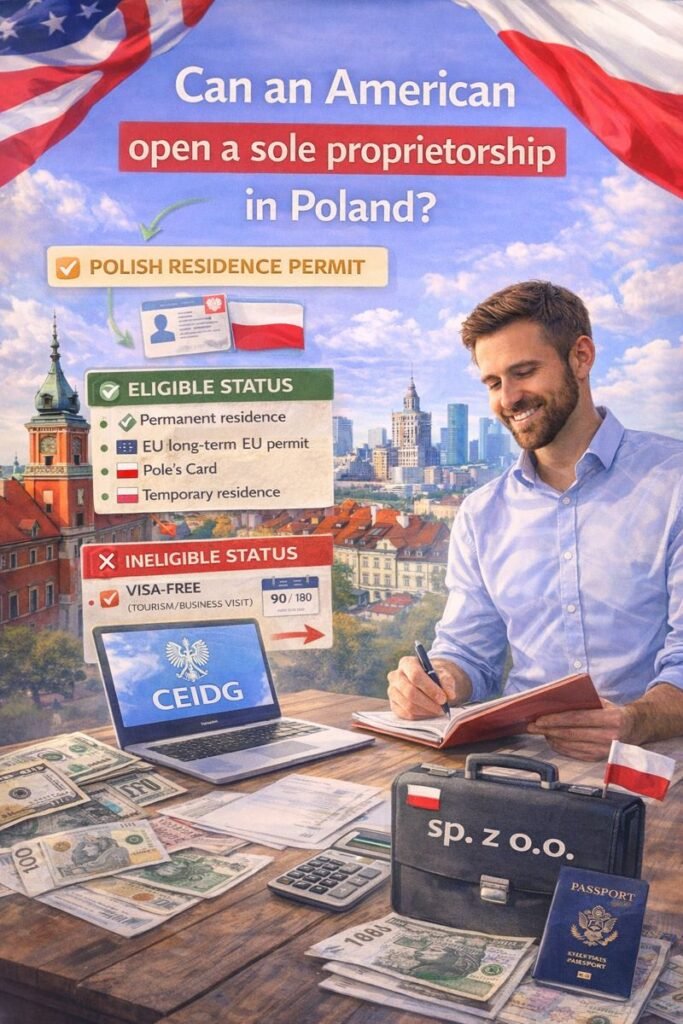
If you’re asking “Can an American open a sole proprietorship in Poland”, the honest answer is: sometimes — but only if you have the right immigration/residency status in Poland. Many Americans can visit Poland easily for up to 90 days, but registering a Polish sole proprietorship (JDG) is tied to specific legal stay/permit categories, and most short-stay statuses don’t qualify.
This guide explains what’s possible, what isn’t, and what Americans typically do instead (often a Polish LLC / sp. z o.o.) — in a practical, step-by-step way.
Not legal advice: This is informational guidance for U.S. citizens; rules and interpretations can change and your case details matter.
Short Answer
Yes, an American can open a sole proprietorship (JDG) in Poland — but only if they’re in Poland on a qualifying status that allows business activity “on the same terms as Polish citizens.”
If you don’t have that status: you generally cannot register a JDG and instead must use a company form (most commonly sp. z o.o.) or other permitted options.
Who can do it easiest
Americans who already have (or can obtain) a Polish status like:
- Permanent residence or EU long-term resident status
- Refugee / subsidiary protection / humanitarian or tolerated stay
- Certain temporary residence permits (examples listed by Polish public sources include family reunification, studies, research, highly-qualified work/Blue Card mobility, etc.)
- A valid Pole’s Card (Karta Polaka)
Who will face limitations
Most Americans who are in Poland on:
- Visa-free short stays (tourism/business visitor) — typically up to 90 days in any 180-day period
- A status that doesn’t grant the right to run a business like a Polish citizen
Legal & Practical Requirements
1) Immigration reality check: visiting ≠ operating a business legally
Americans can generally enter Poland (as part of the Schengen Area) without a visa for short stays, but that doesn’t automatically give you the right to register and run a JDG.
A Polish public information portal (Powroty) summarizes it bluntly:
- Many categories of foreigners can run business in Poland like Polish citizens (it lists specific residence/permit types),
- “Other foreigners” may conduct business only in certain company forms, including limited liability company (sp. z o.o.).
2) What “sole proprietorship” means in Poland (JDG)
A Polish sole proprietorship is called JDG (Jednoosobowa Działalność Gospodarcza) and is registered in CEIDG (Central Registration and Information on Business). It’s usually the simplest/cheapest form for one person — but it’s also the form most tied to personal residence status.
3) Common misunderstandings Americans have
- “I’m visa-free, so I can register a business.” Not necessarily; visa-free entry is about staying, not business registration rights.
- “I can just open a JDG and then apply for residency.” Sometimes people do it the other way around (get a qualifying permit first). Also, a “business activity” residence permit is its own complex pathway (and not a guaranteed shortcut).
- “I can stay 90 days, leave for a weekend, and reset.” The standard rule is 90 days in any 180-day period across Schengen.
Step-by-Step: How an American Can Open a Sole Proprietorship in Poland
This is the practical path if you already have (or are about to have) a qualifying status that lets you run business like a Polish citizen.
1) Confirm you’re eligible to register a JDG
Before you do anything else, confirm your status falls into a category that can run a business like Polish citizens — or accept that you’ll need a sp. z o.o. instead.
2) Decide what you’ll do and choose your PKD codes
Poland uses PKD business activity codes (similar to NAICS/SIC in the U.S.). You’ll select one main code and (optionally) additional codes.
Tip: choose codes that match what you actually do (e.g., IT consulting, marketing services, design, e-commerce).
3) Choose a taxation method
Most JDG owners pick one of these (the right choice depends on your income type, expenses, and whether you need VAT):
- General tax scale (progressive)
- Flat tax
- Lump-sum on revenue (popular for certain service categories)
This is where a Polish accountant is often worth the money.
4) Set up access to Polish e-government tools
To register online, you commonly need a way to sign applications digitally (like a trusted profile / qualified signature). (Poland’s business portals themselves describe online registration as requiring tools like a trusted profile/qualified signature, though some official pages are region-blocked.)
In real life, many foreigners also need:
- a Polish ID number (often PESEL)
- a local address for registration/correspondence
- a Polish bank account (not always required day 1, but very helpful fast)
5) Register the business in CEIDG
If eligible, you submit the CEIDG application (online or via local office). Once registered, your business gets identifiers and is visible in the register.
6) Social insurance and health insurance setup
Most JDG owners must register and pay contributions to ZUS (social insurance). Health coverage is linked to contributions and the public health system NFZ, depending on your situation. (Exact amounts vary by year and tax method.)
7) VAT (if needed)
Many small service businesses don’t need VAT immediately, but if you exceed thresholds or do certain activities, VAT registration matters. This is another “ask an accountant” moment.
8) Keep clean bookkeeping from day one
Even a “simple” JDG becomes painful if you:
- mix personal and business payments,
- ignore invoices/expense documentation,
- forget required filings.
Costs & Fees (What Americans Usually Pay)
Below are typical cost buckets (not a quote). Your largest costs are often monthly contributions + accounting, not the CEIDG registration itself.
Government and administrative fees
- CEIDG registration: often free (the “cost” is mostly bureaucracy/time).
- If you pursue a temporary residence permit for business activity, the EU immigration portal notes fees like PLN 340 (stamp duty) and PLN 100 (residence card), and mentions an indicative processing timeline.
Monthly running costs
- ZUS/social insurance + health contribution: commonly one of the biggest monthly obligations; amounts vary and can change annually.
- Accounting/bookkeeping: depends on volume and VAT status.
- Banking/payment processing: some accounts are free-ish, some aren’t; card processing can add fees.
One-time startup costs people pay for (common in practice)
- Translation of documents (if needed)
- Professional help with registration or tax setup (optional)
- Registered address services (if you don’t have a lease yet)
Common Problems & Mistakes Americans Make
- Assuming eligibility without the right residence status
This is the #1 blocker. If you’re not in an eligible category, don’t waste weeks — plan for sp. z o.o. instead. - Underestimating ongoing contributions
A JDG is “easy to open,” but monthly obligations can feel heavy if income is unstable. - Confusing visitor stay rules with residence/business rights
Visitor rules (90/180) are not the same as the right to reside long-term and run a business locally. - Not planning banking + tax residency
If you’re living in Poland most of the year, Polish tax residency can become relevant (and the U.S. still taxes U.S. citizens globally — separate topic, but important). Consider a cross-border accountant. - Picking the wrong business form
If you’re not eligible for JDG, trying to force it can backfire. A properly set up sp. z o.o. can be the right solution for non-eligible foreigners.
Living in Poland as an American — What Changes in Daily Life
Even if your question is “just” about business setup, your day-to-day setup matters:
Money & payments
- Cards are widely accepted, but Poland is very bank-transfer friendly and many bills/services run on local banking rails.
- You may want both: a U.S. card (for U.S. expenses) and a Polish bank account (for local life + ZUS/taxes).
Healthcare
- Access depends on your insurance setup and status. Many residents use NFZ coverage through contributions; others rely on private insurance/clinics.
Housing & admin
- Many processes want proof of address, registration, and consistent paperwork (leases, bills, statements).
- Expect some documents and portals to be Polish-first.
Work culture & bureaucracy
- Poland is modern in many ways, but still document-heavy. Patience pays.
Is It Worth It for Americans?
Worth it if you:
- already have (or can realistically get) a qualifying residence status,
- want a straightforward “individual” business structure,
- have predictable income and can handle monthly contributions.
Reconsider if you:
- are in Poland only on short-stay rules and hoped JDG would be a fast workaround,
- want to minimize fixed monthly obligations during uncertain income periods,
- need a structure better suited for investors/partners (often sp. z o.o. is cleaner).
Quick pros/cons
Pros
- Simple structure when eligible
- Often fast to register
- Clear “one person = one business” model
Cons
- Eligibility limits for many non-EU foreigners
- Monthly insurance/contribution burden
- Not always the best form for scaling
Alternatives & Related Options
1) Form a Polish company (sp. z o.o.)
If you’re not eligible for JDG, the public guidance explicitly notes that “other foreigners” can do business only via company forms, including sp. z o.o.
2) Stay short-term and operate from abroad
Some Americans keep their business “based” in the U.S. while visiting Poland under 90/180 rules — but that’s a tax/compliance minefield if you’re effectively living/working in Poland.
3) Temporary residence permit for business activity
This exists, but it’s not a “magic button.” The EU immigration portal summarizes fees and general processing expectations, and local voivodeship offices often emphasize how document-heavy it can be.
FAQ (US Intent)
Can Americans do this without speaking Polish?
Yes, many people manage with English + translation help, but you’ll move faster if you have:
- a bilingual accountant,
- translated templates,
- a Polish-speaking helper for offices.
Is it easy for US citizens?
If you’re eligible (right residence status), it can be straightforward.
If you’re not eligible, it’s not “easy” — you’ll likely need a sp. z o.o. route.
How long does it take?
- JDG registration itself can be quick once paperwork and access tools are ready.
- Residency permits (if you go that route) can take longer; the EU portal mentions an indicative timeline and fees, but real-world timing varies by region and application completeness.
How much money do you need?
Enough to cover:
- initial setup costs (translations/help),
- several months of living costs, and
- predictable monthly obligations (social/health contributions + accounting), since income can lag.
Is Poland stricter than other EU countries?
On sole proprietorship access for non-EU nationals: many EU countries tie “individual” business registration to residence status. Poland is not unique — but the exact eligibility categories differ by country.
Conclusion
So, can an American open a sole proprietorship in Poland?
Yes — if you have a qualifying residence/permit status that allows business activity like Polish citizens. Otherwise, the practical path is usually a Polish company (sp. z o.o.), because “other foreigners” are generally limited to company forms.