
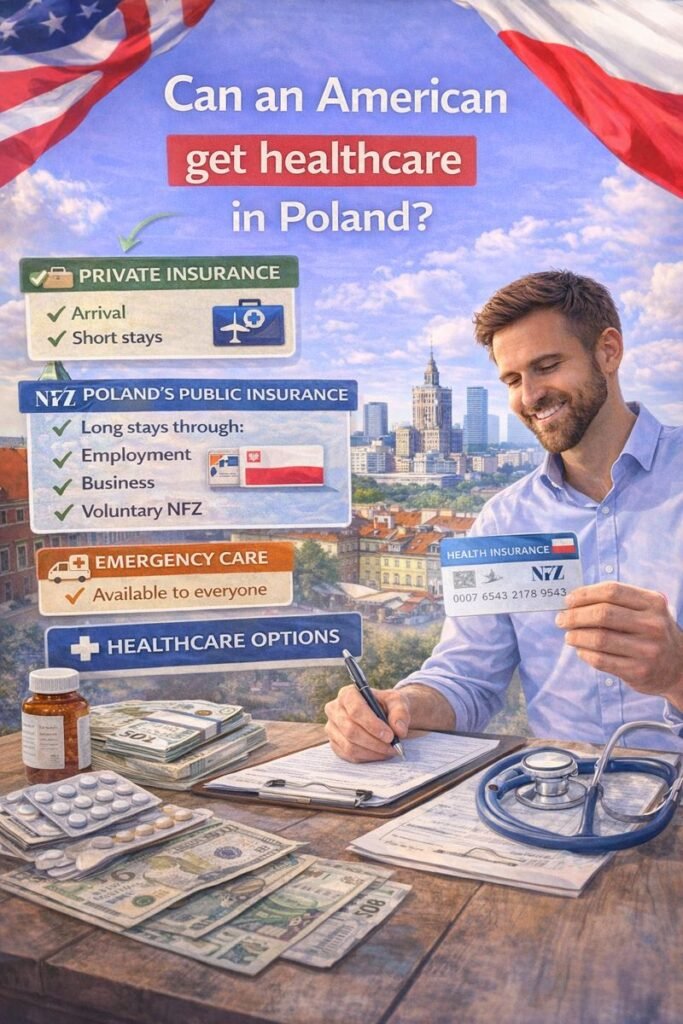
Can an American get healthcare in Poland? Yes — Americans can access healthcare in Poland through (1) private care, (2) Poland’s public system via Narodowy Fundusz Zdrowia (NFZ) if they’re insured, and (3) emergency services regardless of where they’re insured (you’ll still want coverage because bills can add up). In practice, most Americans start with private travel/expat medical insurance, then transition to NFZ coverage once they have a job, register a business, or qualify for voluntary NFZ while legally residing in Poland.
Poland also expects proof of health insurance for many long-stay pathways — for example, official guidance for a national (D-type) visa mentions travel medical insurance with minimum EUR 30,000 coverage for emergencies/hospitalization/repatriation.
Short Answer
Yes — Americans can get healthcare in Poland, and the “best” route depends on your status:
- Short stay (tourism/remote work trial): use private travel insurance + pay out-of-pocket for private clinics when needed. The U.S. State Department strongly recommends ensuring you have overseas coverage and suggests supplemental coverage for medical evacuation.
- Long stay (residence permit, work, study, family): aim for NFZ public insurance (mandatory through work in many cases or voluntary NFZ in others), and optionally add private coverage for faster access and English-speaking clinics.
Legal & Practical Requirements
Public vs private healthcare in Poland
Poland has two main paths:
- Public healthcare funded/managed through NFZ (often “free at point of service” once you’re insured, with some exceptions), and
- Private healthcare, where you pay directly or through private insurance/plans.
Insurance is often required for visas/residence
For long stays, Poland commonly requires proof of insurance as part of immigration documentation. Official government pages for Poland’s D-type national visa specify travel medical insurance with EUR 30,000 minimum coverage for emergency care/urgent hospitalization/repatriation.
EURAXESS (an EU-supported mobility network) also states that health insurance is compulsory and proof is required when applying for a visa and when legalizing your stay.
Common misunderstandings Americans have
- “If I have U.S. insurance, I’m covered.” Many U.S. plans have limited international coverage; you need to confirm it and consider medical evacuation coverage.
- “NFZ is automatic if I live there.” NFZ access depends on being insured (e.g., through employment, business contributions, family coverage, or voluntary enrollment where allowed).
- “Private insurance replaces NFZ for everything.” For some immigration steps, private policies can work as proof, but day-to-day coverage and access differ — and some services are easiest with NFZ.
Step-by-Step: How an American Can Get Healthcare in Poland
1) Start with a “landing” plan (first 30–90 days)
✅ Get travel medical insurance that covers:
- emergency care
- urgent hospitalization
- repatriation/medical evacuation (strongly recommended)
Practical tip: for Poland long-stay visa paperwork, consular guidance may expect the insurance certificate and coverage details (including direct payment to providers in some cases).
2) Decide your main route to long-term coverage
Pick the scenario that matches you:
Route A — You work for a Polish employer
Your employer typically registers you and pays contributions that include health coverage (NFZ access). (This is the most straightforward long-term path.)
Route B — You run a business / are self-employed in Poland
You usually get access through your contribution setup (and you’ll want an accountant to do this correctly).
Route C — You’re legally residing but not covered through work
You may be able to sign up for voluntary NFZ at a regional NFZ branch if you live in Poland and meet conditions (not subject to mandatory insurance, not insured as a family member, etc.).
Route D — You’re a student
Non-EU students often start with private insurance, and many schools also explain the option to enroll in voluntary NFZ after arrival/enrollment.
3) Choose how you’ll actually receive care (public vs private)
Even with NFZ, many foreigners use a hybrid strategy:
- NFZ for hospitals, referrals, major care, prescriptions (where applicable)
- Private clinics for speed, convenience, English-language service, and shorter queues
A migrant-focused info portal summarizes this simply: you can be treated in public (free of charge if insured) or privately (pay yourself), and NFZ coverage may also apply to some private facilities that have NFZ contracts.
4) Know where to go when you’re sick (the practical map)
- Primary care (GP / family doctor): first stop for most issues (referrals for specialists)
- Urgent care / emergency department: serious symptoms (chest pain, severe bleeding, breathing issues, stroke signs)
- Private clinic: minor-to-moderate issues when you want speed/English
If you need help finding providers, U.S. Embassy in Poland maintains medical assistance information and resources for Americans.
Costs & Fees (What Americans Usually Pay)
Costs vary widely by city and provider, but here are the typical buckets Americans should budget for:
1) Insurance costs (private)
- Travel/expat medical insurance premiums depend on age, benefits, and coverage limits.
- For visa/legalization, make sure it meets stated requirements (e.g., minimum EUR 30,000 coverage for certain visa contexts).
2) NFZ contributions (public)
- If you’re employed, contributions are handled through payroll.
- If you enroll voluntarily, you’ll pay a monthly contribution based on the rules of the voluntary agreement (details vary). Regional NFZ branches describe voluntary insurance and administrative steps.
- Students may have preferential terms described by official education resources (one official student portal notes an amount around EUR 15/month in that student context).
3) Out-of-pocket costs (private visits/tests)
Many Americans use private clinics for:
- faster specialist appointments
- same-day visits
- English-speaking service
Even with insurance, you may pay co-pays or full fees depending on your plan.
Monetization-friendly (but not salesy) reality: people commonly pay for help with insurance selection, translations, and English-speaking clinics when navigating Poland’s healthcare system for the first time.
Common Problems & Mistakes Americans Make
Mistake 1: Buying the wrong insurance for visas/residence
Not all policies meet immigration requirements. Government guidance is specific about coverage scope and minimum insured sum in certain cases.
Mistake 2: Assuming NFZ works like U.S. “in-network”
NFZ is a national payer system, but access often depends on using providers with NFZ contracts and following the GP/referral pathway. A simple approach is: GP first, then referral when needed, unless it’s an emergency.
Mistake 3: No documentation ready
For many steps (residence, enrollment, voluntary NFZ), you’ll need paperwork: proof of legal stay, address, and insurance documents. (Requirements can vary by office and situation.)
Mistake 4: Waiting until you’re already sick to figure it out
Do this in week 1:
- know the nearest private clinic
- know the nearest hospital/emergency option
- keep your insurance documents accessible
- save critical numbers and an English-speaking contact if possible
Mistake 5: Skipping evacuation planning
The U.S. State Department recommends considering supplemental insurance for medical evacuation. This matters if you want the option to be transported internationally for care.
Living in Poland as an American — What Changes in Daily Life
Healthcare access is often “faster privately, broader publicly”
Many people use:
- NFZ for foundational coverage
- Private clinics for speed and convenience
That combination is common among foreigners and professionals.
Prescriptions and meds
Carry prescriptions in original packaging and confirm legality for any controlled medications when traveling, per U.S. travel guidance.
Language & admin
In big cities like Warsaw, English-speaking clinics are easier to find, but official paperwork often still expects Polish-language documents and formal formatting.
Is It Worth It for Americans?
Who benefits most
- Americans planning a long stay who want predictable coverage through NFZ (work/business/family)
- Americans who value a hybrid model: public coverage + private speed
Who should reconsider
- People who want to live long-term but refuse paperwork (insurance proof is commonly required for legalization)
- People with complex medical needs who won’t plan ahead (you’ll want to research specialists and facilities early)
Quick pros & cons
Pros
- Clear pathways: private care immediately; NFZ via employment or voluntary options
- Insurance requirements are spelled out for visa contexts
Cons
- Paperwork and eligibility details can be confusing
- Waiting times can be longer in public pathways for non-urgent specialist care (many people choose private for that reason)
Alternatives & Related Options
1) Private-only (short-term)
Good for trial stays and short visits — just make sure you have robust coverage limits and evacuation options.
2) NFZ + private add-on (long-term)
Common for residents: NFZ for core coverage, private for speed/comfort.
3) If you’re studying: student pathways
Some official education resources recommend private insurance prior to arrival and describe voluntary NFZ enrollment after arrival/enrollment.
4) If you’re legalizing your stay
EURAXESS notes you must provide proof of insurance when legalizing stay; plan insurance before you submit applications.
FAQ (MANDATORY – US INTENT)
Can Americans do this without speaking Polish?
Yes — especially with private clinics and larger-city providers. For NFZ and paperwork, translations or an English-speaking helper can make things smoother.
Is it easy for US citizens?
Short-term: yes with private travel insurance.
Long-term: doable, but you must plan insurance proof for visas/residence and arrange NFZ eligibility through your status.
How long does it take?
- Private insurance: same day in many cases.
- NFZ via employment: once you’re registered through payroll.
- Voluntary NFZ: depends on paperwork and regional branch processing.
How much money do you need?
Enough for:
- at least a solid travel/expat medical policy for arrival and visa paperwork (if applicable)
- a buffer for private visits/tests
- potential NFZ contributions if voluntary
Is Poland stricter than other EU countries?
The “proof of insurance for visas/legalization” pattern is common across Europe, and Poland explicitly expects proof in legalization contexts per EURAXESS and government visa guidance.
Conclusion
Can an American get healthcare in Poland? Yes — the most practical path is:
- arrive with strong private medical insurance (often required for long-stay documentation),
- transition to NFZ through work/business/family or voluntary NFZ if eligible, and
- use a public + private hybrid to balance coverage and speed.