
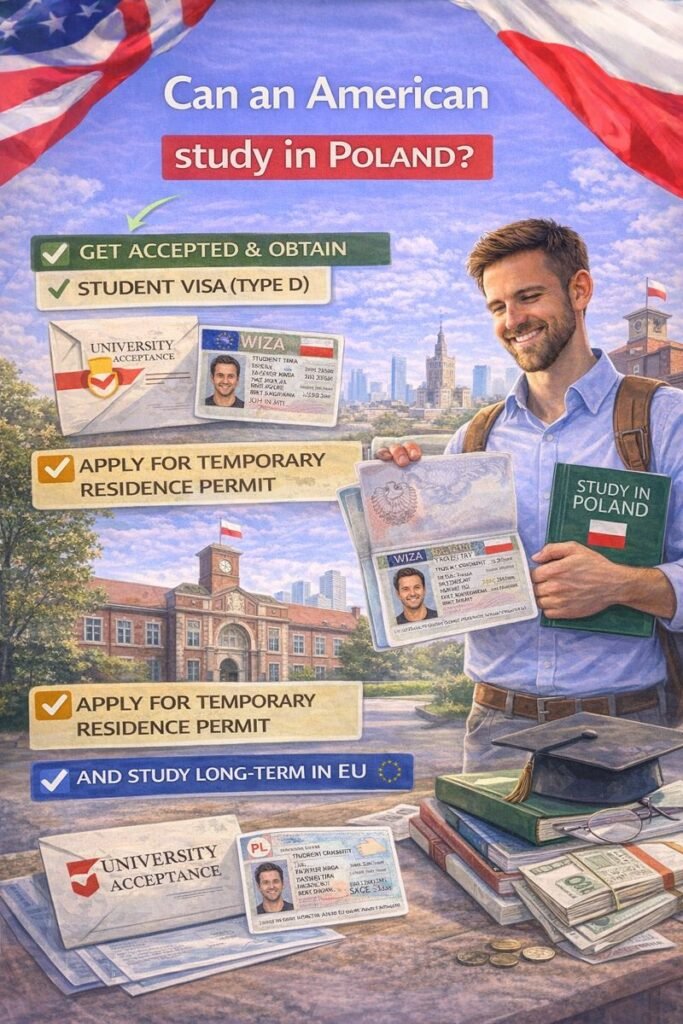
Can an American study in Poland? Yes — and for many Americans, Poland is one of the more practical EU options because programs are widely available (including English-taught degrees), tuition can be comparatively affordable, and the student pathway is well-defined. The main catch is time: as a U.S. citizen, you can’t “just stay and study” long-term on the standard 90 days in any 180-day period rule for the Schengen area. For anything beyond a short course, you typically need a national (Type D) visa and/or a temporary residence permit for studies.
(Informational only — not legal advice.)
Short Answer
Yes — Americans can study in Poland, but the ease depends on what you’re studying and how long you plan to stay:
- Easy: short programs, summer schools, or language courses under 90 days (still subject to Schengen rules).
- Very doable (most degree students): Bachelor’s/Master’s/PhD programs that require a Type D national visa (often up to 1 year) and then a temporary residence permit if you’ll stay longer.
- Harder: last-minute starts, weak documentation (finances/insurance), or trying to “convert” a tourist stay into a long-term study stay without planning.
Legal & Practical Requirements
1) The 90/180 rule still applies to Americans
As a U.S. passport holder, you can usually enter the Schengen area without a visa for tourism/business, but your stay is limited to 90 days within any 180-day period. That’s not a full semester for most university programs.
2) For longer study: Type D visa and/or a student residence permit
For full-degree studies, Poland commonly uses:
- a National visa (Type D) (issued for up to 1 year in general guidance), and
- a temporary residence permit for studies for longer stays or continuation.
The EU’s official immigration portal notes:
- national visas can be issued up to 1 year, and
- the first temporary residence permit for studies is typically granted for 15 months (or for the academic year/program length plus extra time, depending on the case).
3) Health insurance is not optional
For student/long-stay routes, health coverage documentation is a major requirement. Poland’s official visa guidance (example: government consular page) states travel medical insurance must have a minimum coverage of EUR 30,000 and be valid for the period of stay, covering emergencies and related costs.
4) Admissions are handled by each university
There isn’t one central “Poland university application” like Common App. Poland’s Study in Poland portal explains that admissions are administered by the institutions and you apply directly to the university you choose (so requirements vary by school and program).
Step-by-Step: How an American Can Study in Poland
Step 1: Pick the right program and language (English vs Polish)
Start by choosing:
- degree level (Bachelor’s / Master’s / long-cycle Master’s / PhD),
- field (STEM, medicine, business, humanities),
- language of instruction (English programs exist, but not for every major).
Poland’s official Study in Poland portal recommends choosing a program and then checking the university’s admissions rules directly (often via the school’s international office).
Practical tip: If you want the smoothest entry, select programs that:
- publish clear international admissions instructions,
- have experience with U.S. transcripts/diplomas,
- provide an official acceptance letter quickly (you need it for visa planning).
Step 2: Confirm admission requirements early (U.S. diplomas & transcripts)
Because admissions are decentralized, you should expect some combination of:
- high school diploma + transcript (Bachelor’s),
- Bachelor’s diploma + transcript (Master’s),
- proof of language ability (English or Polish),
- possible entrance exams/interviews depending on program.
Study.gov.pl emphasizes contacting the university’s international office well before the course starts to learn the exact procedure and documentation.
Step 3: Get accepted and collect “visa-grade” paperwork
Once admitted, you’ll typically need:
- acceptance letter / enrollment confirmation (the core document for your visa),
- tuition payment confirmation (sometimes required or strongly helpful),
- housing plan (dorm contract, lease, or a plan you can document),
- proof of sufficient funds (how much varies, but expect to show you can cover tuition + living costs),
- compliant health insurance documentation (see EUR 30,000 coverage note).
Step 4: Apply for the Polish national visa (Type D) in the U.S.
Poland’s government consular guidance for a D-type visa includes basics like:
- a completed visa application form (with specific submission steps),
- a valid passport meeting validity criteria and blank pages,
- supporting documents depending on purpose (study = acceptance documents, insurance, finances, etc.).
Study.gov.pl also advises early submission and notes the review can take up to 15 days in typical cases, but warns some cases can take longer.
Practical timeline planning (realistic for Americans):
- Start school selection months ahead
- Aim to have acceptance in hand long before your intended arrival
- Submit visa documents early (summer can get busy)
Step 5: Arrive in Poland and stabilize your “student life setup”
In the first weeks, you’ll want:
- a local address arrangement (dorm/lease),
- Polish SIM/number (for portals and verifications),
- a bank account if needed,
- school registration/student ID processes.
Step 6: If your stay continues, apply for the Temporary Residence Permit before your visa expires
Study.gov.pl is explicit: non-EU students should apply for a Temporary Residence Permit before their visa expires (this is a common “don’t wait until the last moment” issue).
The EU immigration portal adds helpful expectation-setting: the first student temporary residence permit is often issued for 15 months (or aligned to the academic year).
Costs & Fees (What Americans Usually Pay)
Tuition (big picture ranges)
Poland’s Study in Poland portal gives common planning ranges:
- EUR 2,000–6,000 per year (typical tuition range depending on institution and program), and
- English-taught programs average about EUR 3,000/year in their “how to apply” guidance.
The European Commission also publishes a “Study in Poland” overview with similar ballpark tuition figures.
What can cost more than you expect:
- medicine, dentistry, MBA and other premium programs (often significantly higher than general programs)
- big-city housing (Warsaw, Kraków, Wrocław, Gdańsk)
- paid document translations, apostilles, and administrative fees
Visa and residence paperwork costs
Costs vary by consulate and permit type, and they can change — treat them as “line items” in your budget, not afterthoughts.
Health insurance
For the visa/residence path, you’ll need coverage that meets the EUR 30,000 minimum requirement referenced in official guidance.
Common Problems & Mistakes Americans Make
1) Assuming you can study long-term on a tourist stay
The Schengen 90/180 limit is a hard constraint for extended study. If your program is longer than a short course, plan for a D-type visa and then residence steps.
2) Waiting too long for the acceptance letter
Your university acceptance is the cornerstone of the student pathway. Study.gov.pl explicitly builds “acceptance letter and visa preparation” into the process and notes admissions campaigns commonly begin in spring and can run for months.
3) Insurance documents that don’t meet the required wording/coverage
Polish official guidance specifies the EUR 30,000 minimum and what the insurance must cover. Many applicants get delayed because the certificate lacks the required details.
4) Treating “temporary residence permit” as optional
If you’ll remain after your visa period, you need to apply on time. Study.gov.pl tells non-EU students to apply for the permit before the visa expires.
5) Not realizing requirements vary by university
Because admissions are handled by each institution, requirements can differ substantially. The “one-size-fits-all checklist” approach is where a lot of Americans lose time.
Living in Poland as an American — What Changes in Daily Life
Money
- You’ll likely pay in PLN day-to-day, even if tuition is listed in EUR.
- Budget for up-front settlement costs (housing deposit, initial tuition payments, residence filing expenses).
Healthcare
- Your insurance matters not just for emergencies but also for visa/residence compliance (coverage documentation is a core requirement).
Housing
- Student housing can simplify your first month (paper trail + address).
- Private rentals can be great, but may require more admin (deposits, proof of income/guarantor depending on landlord).
Work culture (important if you plan to work while studying)
Rules about working can depend on your status and study mode. The safest approach is to treat work permissions as a separate topic you confirm based on your visa/residence status.
Quality of life
Many Americans find Poland offers:
- strong city infrastructure (especially in larger academic hubs),
- easy regional travel,
- a lower cost base than many Western European capitals (though popular neighborhoods can still be pricey).
Is It Worth It for Americans?
Americans who benefit most
- Students wanting an EU degree in a cost-conscious way
- People targeting English-taught programs in major cities
- Those planning a longer European pathway (study → post-graduate stay → work)
Americans who should reconsider
- If you need “instant, zero-admin” relocation (student pathways have paperwork and timelines)
- If you can’t comfortably document finances/insurance (requirements are strict)
- If you’re hoping to “figure it out after arrival” (that approach causes the most stress)
Pros
- Clearly defined student path (visa → residence permit for longer stays)
- Tuition can be relatively affordable compared with many countries
Cons
- Admin complexity (university-specific admissions + immigration paperwork)
- You must plan around the Schengen time limit for short stays
Alternatives & Related Options
Short-term vs long-term paths
- Short-term study (under 90 days): possible within Schengen limits, depending on your program type and schedule.
- Long-term degree study: usually requires a D-type visa and then a residence permit if you stay beyond the visa period.
Other EU countries (brief mention)
If your primary goal is a specific post-study work route or a particular language environment, other EU countries may be a better match — but they often come with higher tuition/living costs and their own immigration rules.
FAQ (MANDATORY – US INTENT)
Can Americans do this without speaking Polish?
Yes — many programs are offered in English, and large universities have international offices that support foreign students. Admissions are handled by each institution, so choose schools with strong English-language support.
Is it easy for US citizens?
It’s very doable if you plan early. The biggest friction points are admissions timing and immigration paperwork (visa + residence permit planning).
How long does it take?
Typical planning reality:
- University admissions can take months depending on the program cycle.
- Visa processing can be relatively quick in straightforward cases, but you should apply early because some cases take longer.
- If you stay longer, the first student residence permit is commonly issued for up to 15 months (per EU portal), but timelines vary by region and workload.
How much money do you need?
At minimum, plan for:
- tuition (often EUR 2,000–6,000/year, English programs averaging around EUR 3,000/year in general guidance),
- housing + living expenses, and
- insurance that meets the stated minimum coverage requirement.
Is Poland stricter than other EU countries?
Poland is similar to many EU countries in the core structure: a short-stay Schengen rule for visitors, and a formal visa/residence path for longer study.
Conclusion
Can an American study in Poland? Yes — and the key to a smooth experience is planning the “chain” correctly:
- Choose a program and confirm the university’s admissions requirements (they vary).
- Secure your acceptance letter and prepare your visa file (especially insurance + finances).
- For long-term study, use the Type D visa pathway and apply for a temporary residence permit before your visa expires.