
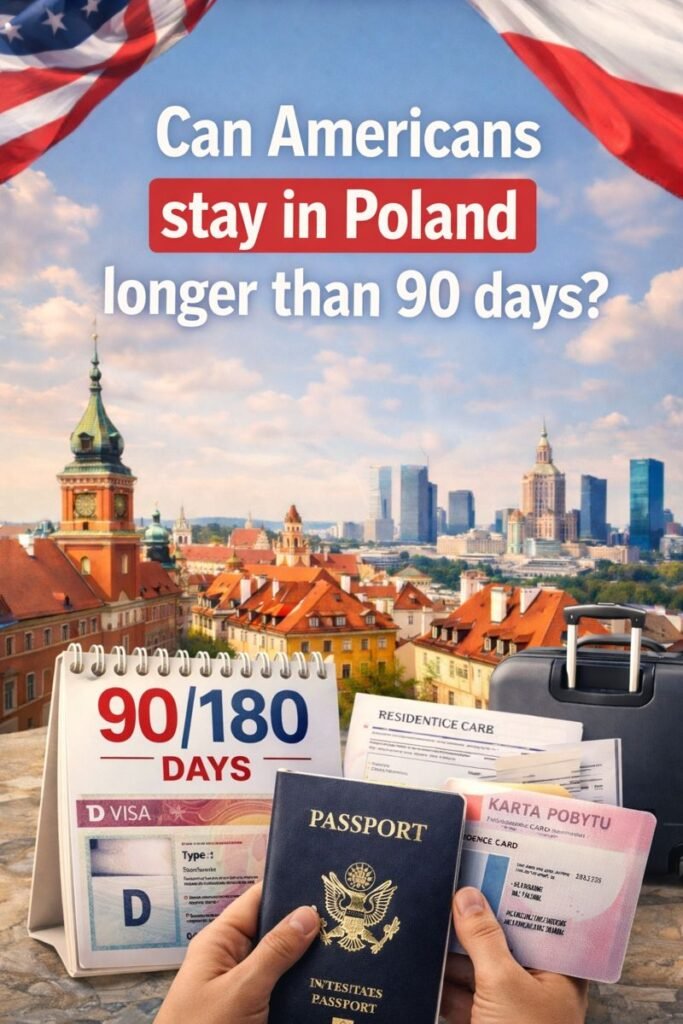
Can Americans stay in Poland longer than 90 days? Yes — but not on visa-free/tourist rules. Americans can generally visit Poland (as part of the Schengen Area) for up to 90 days in any 180-day period, and staying beyond that usually requires a national (D) visa or a Polish residence permit (temporary, permanent, or EU long-term resident).
There’s also an important 2025–2026 update: multiple law firm and official-explainer sources report that the old “extra Poland-only time” practice based on a 1991 U.S.–Poland arrangement is no longer relied on after changes effective October 12, 2025, meaning Americans should plan around the standard Schengen 90/180 rule unless they have a visa or residence permit.
(Informational only, not legal advice. Rules and procedures can vary by consulate and local voivodeship office.)
Short Answer: Can Americans stay in Poland longer than 90 days?
Yes, but only if you switch to a long-stay status, such as:
- National visa (D) — designed for stays over 90 days (validity up to 1 year).
- Temporary residence permit (karta pobytu for a specific purpose like work/study/family/business).
- Permanent residence (only for specific categories).
- EU long-term resident permit (typically after 5 years of legal, continuous residence + requirements like income/insurance; Poland also requires B1 Polish for this status).
If you don’t have a visa or residence pathway, the realistic answer becomes no — you must follow the Schengen 90/180 limit and wait for days to “roll off” before re-entering.
Legal & Practical Requirements
1) Visa-free stays are limited to 90/180
U.S. citizens visiting for tourism/business can stay up to 90 days in any 180-day period in the Schengen Area (including Poland).
2) The Poland “extra 90 days” workaround is no longer a plan
Historically, Americans sometimes relied on an old bilateral arrangement to claim additional time in Poland beyond Schengen. However, practitioner guidance and legal alerts in late 2025 state that Poland terminated that 1991 bilateral visa-waiver practice and U.S. nationals entering or present after October 12, 2025 are subject to the standard Schengen 90/180 rule.
Practical takeaway for 2026: build your plan around D visas or residence permits, not “reset hacks.”
3) If you apply for residence in Poland, you may get a “stamp” — but it has travel limits
Polish authorities explain that if you apply for a residence permit during your legal stay and your application has no formal defects, your passport can be stamped and your stay in Poland is considered legal while the decision is pending — but the stamp does not entitle you to travel abroad.
This is a huge “gotcha” for Americans who want to travel around Europe while waiting: you can be legally “in process” in Poland yet unable to travel normally in Schengen.
Step-by-Step: How Americans can stay in Poland longer than 90 days
Step 1: Pick your “legal anchor” (why you’re staying)
Poland expects a clear purpose such as:
- Work (employment-based route)
- Study (university or eligible program)
- Family (spouse/close family)
- Business / self-employed structure (in specific conditions)
Step 2: Decide whether you need a D visa first
A Polish D-type national visa is explicitly for staying over 90 days in Poland and is valid up to one year.
Many Americans use a D visa as a bridge to move, settle housing, then apply for a residence permit from inside Poland (depending on category and timing).
Step 3: Prepare documents early (this is where most delays happen)
While documents vary by route, most people end up collecting:
- Passport + copies, photos
- Proof of purpose (admission letter, work contract, family documents, business documents)
- Proof of funds/income
- Health insurance proof (commonly required across routes)
- Proof of address (lease, owner declaration)
Step 4: Apply the correct way, before your legal stay expires
If you’re applying for residence from inside Poland, timing matters. Government and voivodeship-office guidance emphasizes applying during legal stay and explains the passport-stamp mechanism once your application is properly submitted.
Step 5: Don’t plan Schengen travel while you’re “pending”
Both official-style guidance and voivodeship explanations make it clear: the stamp does not entitle travel abroad.
The main ways Americans stay longer than 90 days in Poland
Option A: National (D) visa (over 90 days, up to 1 year)
Poland’s official visa guidance says: choose a D-type national visa if you want to stay more than 90 days, and the validity cannot exceed one year.
Best for: a clean “move-in year,” students, people starting a job/study program, or those who need time to transition into a residence permit.
Option B: Temporary residence permit (karta pobytu)
This is the most common “real residency” step after (or instead of) a visa. If you apply correctly and on time, you may receive the stamp confirming lawful stay while processing is ongoing (with travel limits).
Best for: Americans who want stability beyond one year and are ready to build continuous legal residence.
Option C: Business/self-employment pathways (when applicable)
Poland’s “self-employed / business activity” logic is described on EU-level portals and Polish informational sources, but it’s not a casual “remote worker” shortcut; it typically depends on the structure and your role.
Best for: founders/partners with a real business footprint and compliance-ready documentation.
Option D: EU long-term resident status (the “strong indefinite” status)
If your long-term plan is “live in Poland indefinitely,” EU long-term residence is often the strategic target.
Poland’s Office for Foreigners explains:
- eligibility commonly after 5 years of uninterrupted residence (with detailed counting rules),
- the permit is indefinite, while the residence card is renewed periodically,
- and Poland requires Polish language at B1 with accepted evidence types.
Costs & fees (what Americans usually pay)
Costs vary widely, but typical spending falls into:
Official fees
- Visa/residence fees depend on category and local procedure.
- Some routes (like business/self-employed) list specific government fees in informational portals.
“Always happens” private costs
- Certified translations
- Notary/certification needs
- Extra copies, photos, courier/post
- Insurance setup and renewals
Common problems & mistakes Americans make
1) Misunderstanding 90/180
The 90 days are across Schengen, not “90 in Poland, then 90 elsewhere.”
2) Relying on outdated “extra time” advice
2026 planning should assume standard Schengen enforcement for Americans in Poland after October 12, 2025.
3) Filing late and hoping the application “fixes” overstay risk
The stamp and lawful-stay-while-pending logic depends on filing during legal stay and curing formal defects.
4) Traveling during a pending case
The stamp generally does not allow travel abroad; leaving can cause re-entry problems.
5) Underestimating paperwork friction
Even when you qualify, small missing items can turn into months.
Living in Poland as an American — what changes in daily life
- Time horizons get longer. Think in 6–12 month blocks for paperwork rather than quick U.S.-style onboarding.
- Healthcare/insurance becomes a residency habit, not a one-time purchase.
- Travel planning changes if you’re waiting on a decision (stamp period).
- Language matters more in official contexts than in day-to-day city life (especially for long-term goals like EU long-term resident).
Is it worth it for Americans?
Worth it if you:
- Have a clear basis (study/work/family/business)
- Want EU-based living and can handle bureaucracy
- Can plan for continuity toward long-term status
Reconsider if you:
- Only have “tourism + hope”
- Want to bounce around Schengen freely while “pending”
- Need a guaranteed fast timeline
Pros
- A structured path to long-term stability
- Strong long-term options once your status is established
Cons
- Admin delays and paperwork
- Travel limitations during processing
Alternatives & related options
If your real goal is “Europe longer than 90 days” (not necessarily Poland), some Americans choose countries with clearer long-stay frameworks for their situation (study, remote-work categories elsewhere, ancestry routes, etc.). If Poland is the goal, the cleanest plan is typically: D visa or residence permit route from day one, not relying on legacy loopholes.
FAQ (US Intent)
Can Americans stay in Poland longer than 90 days without speaking Polish?
Yes, it’s possible—especially in large cities—but paperwork is easier with Polish help (translator/consultant). Long-term EU resident status adds a Polish language requirement (B1).
Is it easy for U.S. citizens?
It’s doable, but not automatic. Your passport helps for entry, but long-stay depends on visas/residence rules.
How long does it take?
A D visa can be granted for up to a year; residence permits can take months and vary by location. If your target is EU long-term resident status, plan on about 5 years of qualifying legal residence.
How much money do you need?
Enough to support yourself and meet insurance/document requirements—exact expectations vary by route, but proof of means and insurance are common.
Is Poland stricter than other EU countries?
It depends on your profile. Poland’s long-term EU resident rules are detailed and predictable, but processing speed and local practice vary.
Conclusion
Can Americans stay in Poland longer than 90 days? Yes — with the right long-stay visa (D) or a residence permit. Without that, Americans should plan around the Schengen 90/180 rule, and in 2026 it’s especially important not to rely on outdated “extra Poland days” advice after the post-October 12, 2025 changes reported by legal advisories.