
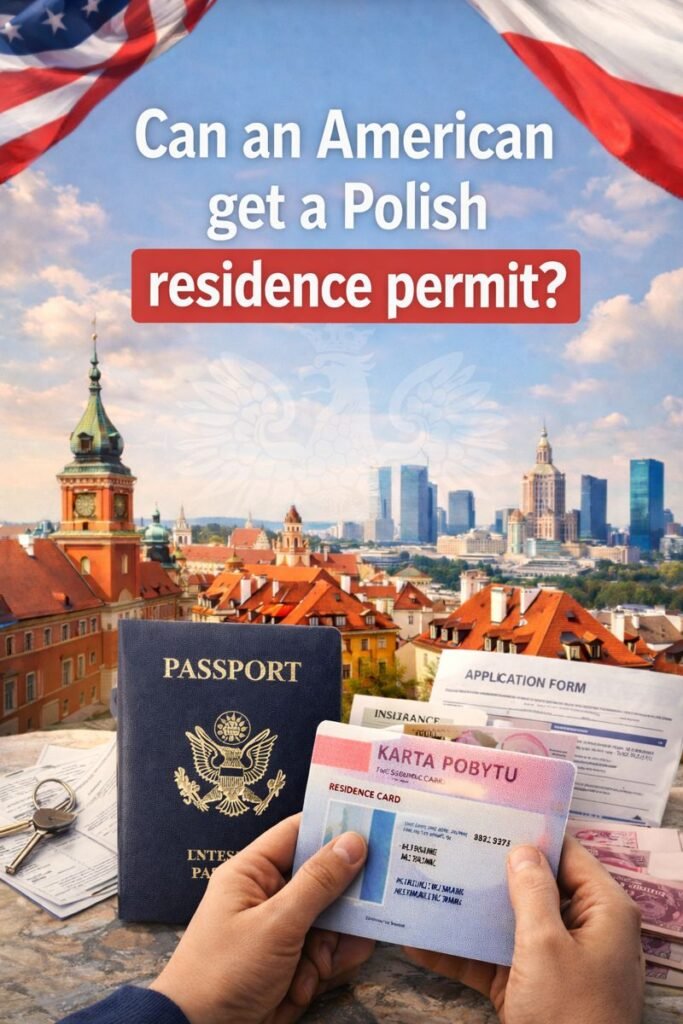
Yes — Can an American get a Polish residence permit? In most cases, yes, as long as you have a valid reason (work, studies, family, business, etc.) and you apply correctly and on time. The key is understanding that visa-free entry (tourist rules) is not the same thing as residency. Americans can visit Poland under Schengen short-stay rules, but a Polish residence permit (temporary/permanent/EU long-term) requires a formal application through the local voivodeship office and supporting documents.
This article is informational only and not legal advice. Rules can vary by your situation and by voivodeship office practice.
Short Answer
Yes, Americans can get a Polish residence permit, but the “easy” path depends on your purpose:
- Easiest: Americans with a job offer, a university admission, a Polish/EU spouse, or a clear qualifying business setup.
- Harder: Americans trying to stay long-term without a clear legal basis (tourism alone doesn’t become residency). Poland generally expects you to switch to a national (D) visa or residence permit for stays beyond 90 days.
Legal & Practical Requirements
1) Tourist rules are not residency rules
Americans can often enter for short stays under Schengen rules, but residency is a different legal regime and requires a permit/visa pathway. (For long stays, Poland directs people toward D visas or residence permits.)
2) You usually apply in Poland, in person, and timing matters
Multiple official/voivodeship guidance pages emphasize that a temporary residence application should be submitted in person and no later than the last day of your legal stay in Poland, with fingerprints required.
3) Poland’s MOS portal can help you prepare (and sometimes submit) correctly
Poland’s Office for Foreigners explains that the MOS portal is designed to help people prepare residence applications and avoid mistakes (including form wizards and guidance).
4) Long-term goals have extra requirements
If your real target is “indefinite” status, Poland’s Office for Foreigners explains the EU long-term resident permit generally requires 5 years of uninterrupted residence and includes specific rules about what time counts.
Language can also matter: Poland’s guidance and voivodeship explainers note Polish language confirmation is required for long-term EU resident permits (commonly B1).
Step-by-Step: How an American Can Get a Polish Residence Permit
- Pick your legal basis (“why you’re staying”)
Most successful applications start with a clear category: work, studies, family, or business activity. MOS organizes temporary residence info by “purpose of stay,” which is exactly how Poland processes these cases. - Decide whether you need a National (D) visa first
If you plan to stay longer than 90 days, a D-type national visa is Poland’s standard long-stay visa and can be valid up to one year.
Many Americans use a D visa as a “bridge” to move, settle housing, then pursue a residence permit (depending on category and timing). - Build your document pack early (before the last weeks)
Exact lists vary, but most routes require: proof of purpose, proof of funds/income, insurance, and housing/address documents, plus standard ID copies and photos. MOS pages for specific purposes highlight that you must show a valid travel document and attach necessary documents (and provide fingerprints). - Submit the application in the correct voivodeship (region)
You apply where you live. Many voivodeship guidance pages repeat the same rule: submit in person and on time; fingerprints are required. - Fingerprints + formal checks
If you submit by post, some offices still require an in-person appearance for fingerprints; voivodeship guidance warns that failure to appear can cause the application to be left unprocessed. - Plan your travel carefully while the case is pending
It’s common in Poland that you can remain while your case is processed if you filed properly and on time, but people often get surprised by travel limitations during the pending period. (Local voivodeship guidance frequently explains this in detail—treat international travel as “high risk” unless you’ve confirmed your exact status.)
Costs & Fees (What Americans Usually Pay)
Costs vary by permit type and region, but Americans typically pay in these buckets:
Government and admin fees
- Permit and card issuance fees depend on category.
- For business/self-employment residence, the EU immigration portal summarizes typical fees like stamp duty and residence card fees for that route.
Document and compliance costs (the “always happens” list)
- Certified translations (very common for U.S. documents)
- Copies, photos, courier/post
- Health insurance coverage (often required in practice across routes—especially studies and many residence cases)
Common Problems & Mistakes Americans Make
1) Treating “visa-free” like a residency strategy
Tourist access can help you scout Poland, but it doesn’t create residency rights by itself. Poland pushes longer stays into D visas/residence permits.
2) Applying too late
Multiple official/voivodeship resources emphasize: file no later than the last day of legal stay. Waiting until the final week is one of the biggest avoidable risks.
3) Underestimating fingerprint and in-person requirements
If you don’t appear for fingerprints when required, your case can stall or be left unprocessed.
4) Assuming “remote income” automatically qualifies you
Remote income can help you show financial stability, but you still need the correct legal basis (work/studies/family/business). MOS frames residence permits by purpose, not by “I have savings.”
5) Not planning for long-term requirements early
If your long-term plan is EU long-term resident status, understand the 5-year continuity and language confirmation expectations early, so you don’t accidentally create gaps.
Living in Poland as an American — What Changes in Daily Life
Money
You’ll likely be asked to show consistent proof of funds, contracts, or bank statements during residence steps. Keep clean records from day one.
Healthcare
Insurance is not just “nice to have.” In many visa/residence pathways (especially study-related processes), proof of insurance is explicitly listed as part of preparation.
Housing
Leases and address proofs matter beyond comfort—they can become part of your residency file. Consistency helps.
Work culture and bureaucracy
Poland can feel more document-heavy than the U.S. The MOS portal exists largely because application mistakes are so common.
Is It Worth It for Americans?
Worth it if you:
- Have a strong basis (work, studies, family, business activity)
- Want long-term stability and can tolerate paperwork cycles
- Can plan for continuity and, if relevant, language goals
Reconsider if you:
- Want to “just stay” without a qualifying purpose
- Need fast, guaranteed timelines
- Plan lots of Schengen travel while your first application is in process (timing/travel can get tricky)
Pros
- Clear pathways exist; long-term status is possible with continuity
Cons
- Bureaucracy, wait times, and documentation load are real (and vary by region)
Alternatives & Related Options
If your goal is “Europe” more than “Poland,” you might compare other EU countries’ residence frameworks (some are more explicitly designed for remote workers or specific profiles). But if Poland is the goal, the most reliable strategy is: choose the right legal basis early (often via D visa or a clear residence category), apply on time, and maintain continuity.
FAQ (MANDATORY – US INTENT)
Can Americans do this without speaking Polish?
Often yes for day-to-day life (especially in major cities), but official procedures can be easier with Polish help. For EU long-term resident status, language confirmation is explicitly required.
Is it easy for US citizens?
It’s doable, but not automatic. Success depends on having a clear legal basis and submitting a correct file (MOS exists to reduce mistakes).
How long does it take?
Processing times vary by region and case complexity. Some informational guidance notes formal case deadlines for temporary residence processes (e.g., 60 days counted from when key steps are completed), but real timelines can be longer depending on practical workload.
How much money do you need?
Enough to support yourself and meet the requirements for your route (often including insurance and stable resources, especially for long-term statuses).
Is Poland stricter than other EU countries?
It depends on your profile and where you apply. Poland’s long-term EU resident framework is detailed (5 years + language confirmation), but local timelines differ.
Conclusion
Can an American get a Polish residence permit? Yes — and the most practical approach is to treat it like a project: pick a legal basis (work/study/family/business), prepare documents early, apply in person and no later than the last day of legal stay, complete fingerprints, and plan around continuity if you want stronger long-term status later. The MOS portal and the Office for Foreigners’ guidance are your best starting points for doing this cleanly.