
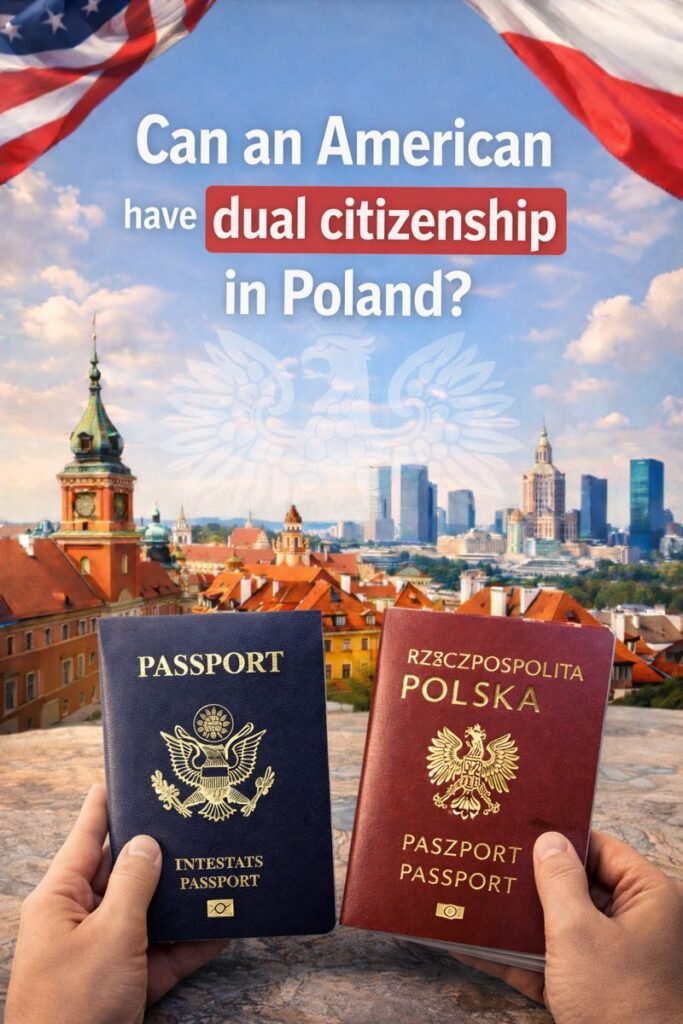
Can an American have dual citizenship in Poland? In most cases, yes — Americans can typically keep U.S. citizenship while also holding Polish citizenship. The important nuance is that Poland generally treats you as Polish when you’re in Poland, meaning you should expect to use Polish documents with Polish authorities and at border control, and you may have Polish civic obligations.
This article is informational only, not legal advice. Citizenship rules depend on your facts (especially ancestry timelines and any historical loss of citizenship). Always verify with official sources or a qualified professional.
Short Answer
Yes — Americans can have dual citizenship with Poland, because:
- U.S. law does not require choosing one nationality, and U.S. citizens may naturalize elsewhere without automatically losing U.S. citizenship.
- Poland generally does not require you to renounce your prior citizenship when you acquire or confirm Polish citizenship.
- Poland may not “recognize” dual citizenship in the way Americans expect, meaning Polish authorities can treat you only as Polish in Poland (you can’t rely on U.S. citizenship in dealings with Polish offices).
Who can do it easily:
- Americans who qualify for Polish citizenship by descent (often you’re already Polish under Polish law and just need confirmation).
Who may face limitations:
- Dual nationals who expect U.S. consular help inside Poland the same way a normal U.S. visitor would; Poland may treat you strictly as Polish.
Legal & Practical Requirements
1) “Dual citizenship” vs “Poland treats you as Polish”
A key rule repeated in Polish public guidance is that if you have Polish citizenship plus another citizenship, you still have the same rights and obligations toward Poland as a person who only has Polish citizenship — and you generally cannot rely on the other citizenship in front of Polish authorities.
Poland’s Ombudsman site also summarizes the Border Guard’s position: multiple citizenship can be tolerated, but a dual citizen is treated as if they have only Polish citizenship for certain legal purposes (including border-control expectations).
2) U.S. rules: you can usually keep U.S. citizenship
U.S. Department of State states that U.S. law does not require a U.S. citizen to choose between U.S. citizenship and another nationality, and that naturalizing elsewhere does not automatically risk U.S. citizenship.
3) Poland’s practical approach: you don’t “lose Polish” just by becoming American
U.S. Embassy in Poland explains that Polish citizens who became naturalized U.S. citizens after a certain date generally do not lose Polish citizenship under Polish law unless they formally renounce it through the proper procedure.
4) Travel reality: expect to use Polish documents in Poland
If you hold Polish citizenship, Poland can require you to identify as Polish at the border and in administrative matters. Border Guard guidance summarized via the Ombudsman indicates dual citizens may need to present Polish documents for leaving/entering Poland.
(Practical tip: dual citizens often carry both passports, but use the Polish one where Poland expects it.)
Step-by-Step: How an American Can Have Dual Citizenship in Poland
This isn’t a special “dual citizenship application.” Dual citizenship happens when you become (or confirm that you already are) a Polish citizen while keeping U.S. citizenship.
Step 1: Figure out how you qualify for Polish citizenship
Most Americans fit into one of these buckets:
- Citizenship by descent (confirmation)
If you have a Polish parent/grandparent (and sometimes further back), you may already be Polish under Polish law and need to confirm possession of Polish citizenship. - Recognition as a Polish citizen (residency-based “earned” route)
Typically requires legal residence and other conditions; it’s structured and document-heavy. (Poland’s official citizenship service pages outline the pathways.) - Citizenship granted by the President (discretionary)
You can apply, but it’s discretionary, so outcomes can be less predictable.
Step 2: Collect the documents that prove your case
Common document categories:
- U.S. civil documents (birth/marriage/divorce)
- Polish civil documents for your ancestor(s) (if descent)
- Name-change proof across generations (very common issue)
- Certified translations (often required in practice)
Step 3: Apply through the correct channel
- Many people abroad file through a Polish consulate; people in Poland often file through the relevant voivodeship route depending on procedure (your pathway determines where it goes).
Step 4: After approval/confirmation, handle passports and IDs
Once you are Polish:
- You’ll likely want a Polish passport/ID for Poland/EU use (and to avoid border friction).
- You keep your U.S. passport for U.S. travel and identity as a U.S. citizen.
Costs & Fees (What Americans Usually Pay)
Costs vary widely depending on whether you’re descent (paper chase) or residency-based (longer compliance arc). Typical cost buckets:
Government fees
- Application-related fees exist and can change over time; verify for your exact procedure at the point of filing.
(Some news-style/legal sites report fee changes, but always confirm on official government pages for your exact form/type.)
“Real-world” private costs (most common for Americans)
- Document retrieval (archives, civil registry copies)
- Certified translations
- Notary/certification / apostilles (case-dependent)
- Language exam prep (if your route requires Polish proficiency)
Common Problems & Mistakes Americans Make
1) Confusing “allowed” with “recognized”
People say “Poland allows dual citizenship,” but what matters day-to-day is that Poland may treat you only as Polish in Poland. That’s why you can’t rely on your U.S. status with Polish authorities.
2) Assuming U.S. consular protection works the same way
Travel advisories warn that countries may restrict consular assistance to dual nationals when those nationals are treated as citizens of that country. Canada’s Poland travel advice explicitly notes Poland does not recognize dual citizenship (in the consular-context sense).
3) Not planning border/ID logistics
Dual nationals commonly run into friction when they show only a foreign passport where Polish officials expect Polish documents. Border Guard guidance highlights the “treated as Polish” approach.
4) Underestimating ancestry paperwork complexity
Descent cases often fail (or stall) due to:
- name spelling changes,
- missing birth/marriage acts,
- unclear lineage links,
- historical citizenship-loss edge cases.
5) Ignoring U.S. tax and reporting realities
Dual citizenship doesn’t erase U.S. tax obligations. Many Americans abroad still have U.S. filing responsibilities. (This is a tax topic—get professional advice for your situation.)
Living in Poland as an American Dual Citizen — What Changes in Daily Life
Money
As a Polish citizen, you can open doors that are easier for EU citizens (employment, business registration, fewer residence renewals), but you also need to manage cross-border financial organization (accounts, compliance, and tax planning).
Healthcare
Citizenship can simplify access routes compared with temporary permits, but your actual healthcare coverage depends on your work/insurance status and Polish system rules.
Housing
Nothing magical changes overnight, but having Polish/EU status can reduce paperwork hurdles (landlords, long-term stability perception).
Work and mobility
A Polish passport gives you EU mobility advantages, and removes the “renewal treadmill” that many non-EU residents deal with.
Is It Worth It for Americans?
Worth it if you:
- Have Polish ancestry and can document it
- Plan long-term life in Poland/EU
- Want to simplify residence/work rights
Reconsider (or prepare carefully) if you:
- Expect U.S. consular protection inside Poland to work the same as for non-Polish U.S. tourists
- Don’t have the documents (yet) and need quick results
Pros
- Long-term stability and EU rights
- No need (in general) to give up U.S. citizenship
Cons
- Poland may treat you only as Polish in Poland
- Heavy paperwork, especially for descent cases
Alternatives & Related Options
If you don’t qualify for citizenship now but want long-term Poland/EU life:
- Start with legal residence, then evaluate citizenship pathways later (recognition, etc.). Poland’s official citizenship pages outline the available procedures.
If you do have ancestry:
- Start with confirmation research before assuming you need “naturalization.”
FAQ (US INTENT)
Can Americans have dual citizenship in Poland without speaking Polish?
Often yes if your route is citizenship by descent (confirmation). Language requirements depend on the pathway; some residency-based routes may require Polish proficiency. (This varies by procedure.)
Is it easy for U.S. citizens?
It can be very straightforward if you clearly qualify by descent and can document it. Otherwise it can be paperwork-heavy.
How long does it take?
It varies by pathway, document availability, and workload. Descent cases often hinge on how quickly you can obtain archival records.
How much money do you need?
Budget for document retrieval + certified translations + application fees (and possibly professional help if your case is complex).
Is Poland stricter than other EU countries about dual citizenship?
Poland’s unique “feel” is that it may not recognize dual citizenship in dealings with authorities and treats you as Polish in Poland—many countries have a similar approach, but the practical impact varies by country.
Conclusion
Can an American have dual citizenship in Poland? Yes: the U.S. generally permits dual nationality, and Poland generally does not require Americans to renounce U.S. citizenship when acquiring/confirming Polish citizenship. The key practical rule is that Poland may treat you as Polish in Poland, so plan to use Polish documents with Polish authorities and understand the limits on relying on your U.S. citizenship there.