
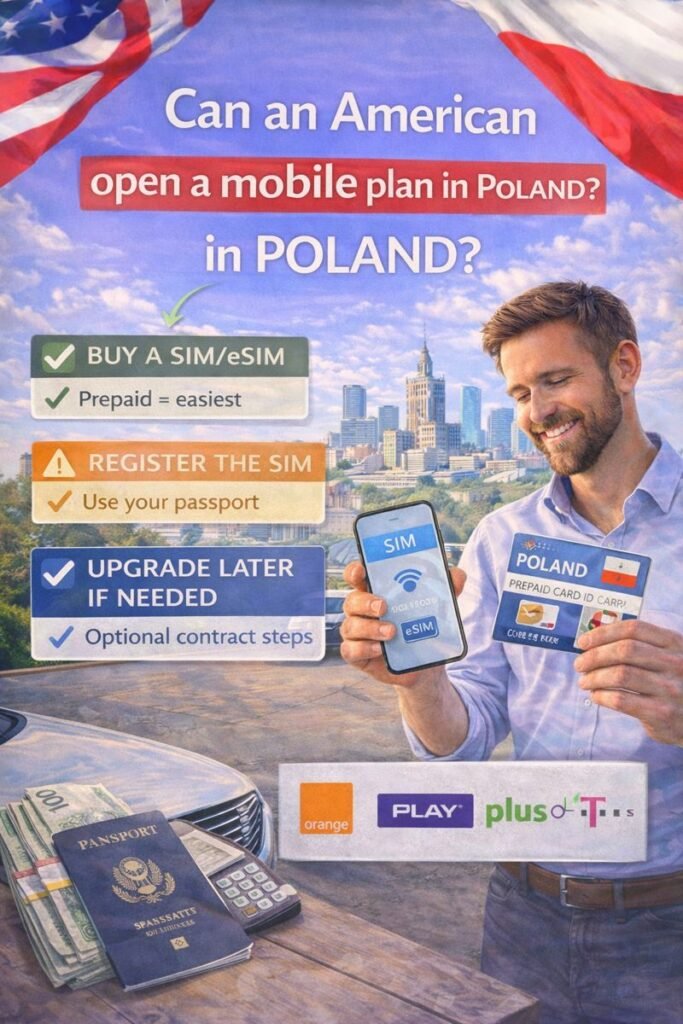
Can an American open a mobile plan in Poland? Yes — Americans can usually get mobile service in Poland the same day, most commonly by starting with a prepaid SIM/eSIM and then switching to a postpaid contract (“abonament”) once they’re settled.
The key thing to know up front: SIM registration is mandatory in Poland, so you’ll need to register the SIM (or eSIM) using an identity document (typically your passport, and sometimes a residence card depending on the operator and your situation). Operators openly describe registration as mandatory and explain how to do it.
(Informational only — not legal advice.)
Short Answer
Yes — Americans can open a mobile plan in Poland.
- Easiest option (recommended for newcomers): Prepaid (“na kartę”) — buy a starter pack and register it with your passport.
- Best long-term option (if you want a monthly contract, device financing, etc.): Postpaid contract (“abonament”) — possible, but it can require more in-person steps and additional details (some operators note you may need to sign in-store if you don’t have a PESEL number).
Legal & Practical Requirements
SIM registration is mandatory
Polish mobile operators repeatedly emphasize that you must register a SIM to use it. For example, Play states SIM registration is mandatory and can be done in-store (or via electronic verification in some cases).
T-Mobile Polska also publishes a registration page listing identity documents (passport, residence card, Polish ID) needed to register a prepaid number.
What documents Americans typically need
In practice, for an American visitor or new resident, expect to use:
- Passport (most common)
- Residence card (karta pobytu) if you have one (some operators explicitly mention it for non-EU foreigners)
- Sometimes: additional data like a local personal number (PESEL) may make postpaid contracts easier, but it’s not always required for prepaid. (Operator rules vary — see “Prepaid vs Postpaid” below.)
Prepaid vs postpaid: what Americans should choose
Prepaid (“na kartę”)
- You pay upfront (top-ups) and can stop anytime.
- Usually easiest for Americans who just arrived, don’t yet have Polish paperwork, and want service instantly.
- Registration still required, but it’s usually quick in-store or via operator channels.
Postpaid contract (“abonament”)
- Monthly billing, sometimes better bundles and device installments.
- Some providers may require more verification. For instance, T-Mobile notes that if you don’t have a PESEL, you can sign a contract only in a store.
Step-by-Step: How an American Can Open a Mobile Plan in Poland
Step 1) Decide: physical SIM or eSIM
- Physical SIM: easiest if you want a quick starter pack at a store/kiosk.
- eSIM: great if your phone supports it and you want digital setup without swapping plastic.
Orange Flex (an app-based offer) explains eSIM and notes that major Polish operators offer eSIM, though activation flows differ.
Step 2) Pick your “starter” operator (the big 4)
Poland’s major operators commonly listed by universities and official student info pages include:
- Orange Polska
- Play
- Plus
- T-Mobile Polska
Step 3) Buy a starter pack (prepaid) in the easiest places
Common purchase points:
- operator stores (best if you want help in English)
- supermarkets, kiosks/newsstands, gas stations
Tip for Americans: if you’re tired after a flight, operator stores are usually easiest because staff can handle both purchase + registration cleanly.
Step 4) Register your SIM (the step people miss)
Examples of how registration works by operator:
- Play: says registration is mandatory and can be done in-store or via electronic verification with selected banks (where available).
- T-Mobile: lists identity documents (passport/residence card/Polish ID) and indicates you’ll need the SIM number to register.
- Plus: knowledge base states you need identity document details and notes that for foreigners outside the EU a residence card may be required; it also provides registration methods.
- Orange: has a dedicated “for foreigners” page with prepaid options aimed at foreigners/tourists.
Practical rule: If you’re not sure, register in an official operator store — fastest, lowest risk.
Step 5) Activate your package + set up top-ups
Once registered, you’ll typically:
- activate a data/calls bundle via app/USSD code
- top up online, in convenience stores, or at kiosks (prepaid)
University guidance notes top-ups are widely available and that prepaid numbers may need occasional top-ups to stay active (rules vary by operator).
Step 6) Upgrade later to a contract (optional)
When you’ve got:
- a stable address,
- stronger local documentation,
- and you want a better long-term plan,
…go in-store to ask about a contract. Again, T-Mobile explicitly highlights the in-store requirement if you don’t have PESEL.
Costs & Fees (What Americans Usually Pay)
Prices change constantly, but Americans usually pay in these buckets:
1) Starter pack cost (prepaid)
- Small upfront cost for the SIM + initial credit/package (varies by operator and promo).
2) Monthly bundles (prepaid or postpaid)
- Most people choose a monthly bundle with data + calls/texts.
Example of a concrete offer (so you can sanity-check what “normal” looks like):
Orange advertises a prepaid offer for foreigners with unlimited calls/texts/MMS + 75 GB for one month (details and eligibility depend on the specific starter).
3) eSIM / app-based plans
- Some offers are app-first and can be convenient for foreigners (especially if you prefer to manage everything in English). Orange Flex is a well-known example of app-guided eSIM activation.
4) “Hidden” costs Americans forget
- Phone compatibility (US models sometimes differ in LTE/5G band support; most modern iPhones are fine, but it’s worth checking if you have an older phone).
- Roaming expectations (if you’ll travel around the EU, confirm your plan’s EU roaming rules).
Common Problems & Mistakes Americans Make
1) Buying a SIM but not registering it
Because registration is mandatory, an unregistered SIM may not work (or may stop working). Operators explain registration steps clearly — follow them on day one.
2) Assuming a US driver’s license is acceptable ID
Many registration processes want a passport or residence document. Use your passport to avoid wasting time.
3) Trying to sign a postpaid contract online without local identifiers
Some operators say contract signup may require in-store identity verification, especially without PESEL.
4) Forgetting your phone might be carrier-locked
If your phone is locked to a U.S. carrier, Polish SIM/eSIM activation will be a headache. Check unlock status before you leave the U.S.
5) Choosing the wrong product for your real needs
- If you mostly use WhatsApp/iMessage, prepaid data-heavy plans are often enough.
- If you need a Polish number for deliveries, banking, government portals, and HR forms, choose a plan with reliable SMS and easy top-up.
Living in Poland as an American — What Changes in Daily Life
Money and payments
- You’ll top up prepaid via apps, kiosks, or convenience stores, and manage bundles monthly.
Bureaucracy and online accounts
- A Polish phone number can be useful for SMS verification (banking, delivery apps, portals).
- Long-term, contract plans can simplify “monthly life,” but prepaid is usually the fastest start.
Language and support
- In major cities, operator stores often have staff who can help in English, but the apps and terms can still be Polish-heavy depending on operator.
Quality of life
- Once you have a Polish number + mobile data, the practical “settling in” part gets much easier: maps, tickets, rides, deliveries, banking.
Is It Worth It for Americans?
Yes — for most Americans living in or visiting Poland, getting a local plan is worth it because it reduces:
- roaming cost surprises,
- data throttling,
- and reliability issues for everyday verification and apps.
Best for: anyone staying longer than a short tourist trip, remote workers, students, and relocators.
Maybe not necessary: very short trips where a travel eSIM is cheaper and you don’t need a Polish number.
Alternatives & Related Options
1) Travel eSIM (data-only) for short stays
Good if you just want data immediately and don’t need a Polish phone number.
2) Prepaid Polish SIM (balanced option)
Best “first month” choice for most Americans: local number + easy control of spending.
3) Postpaid Polish contract (best long-term, more paperwork)
Great if you want the best bundles or device financing, but expect in-store verification and possibly additional requirements depending on the operator.
FAQ (MANDATORY – US INTENT)
Can Americans do this without speaking Polish?
Yes. The easiest path is going to an operator store and registering with your passport. Operator pages confirm registration is mandatory and describe how to do it.
Is it easy for US citizens?
Generally yes — prepaid is usually easy the same day. Postpaid contracts can be more paperwork-heavy.
How long does it take?
- Prepaid purchase + registration in-store: often 10–30 minutes (depending on queues).
- Contract signup: can take longer due to verification and plan selection (and may require store visits).
How much money do you need?
Enough for:
- a starter pack,
- a monthly bundle,
- and occasional top-ups.
As a reference point, Orange’s “for foreigners” prepaid offer example includes a 1-month bundle with unlimited calls/texts/MMS + 75 GB.
Is Poland stricter than other EU countries?
Poland is one of many countries where prepaid SIM registration is standard. The practical takeaway: plan to register with your passport the same day you buy the SIM.
Conclusion
Can an American open a mobile plan in Poland? Yes — and the most reliable approach is:
- start with a prepaid SIM/eSIM,
- register it with your passport immediately,
- switch to a postpaid contract later if you want long-term perks.
If you tell me your use case (data-only vs calls/SMS, eSIM vs physical SIM, city you’ll live in), I can recommend the best “first month” setup.