
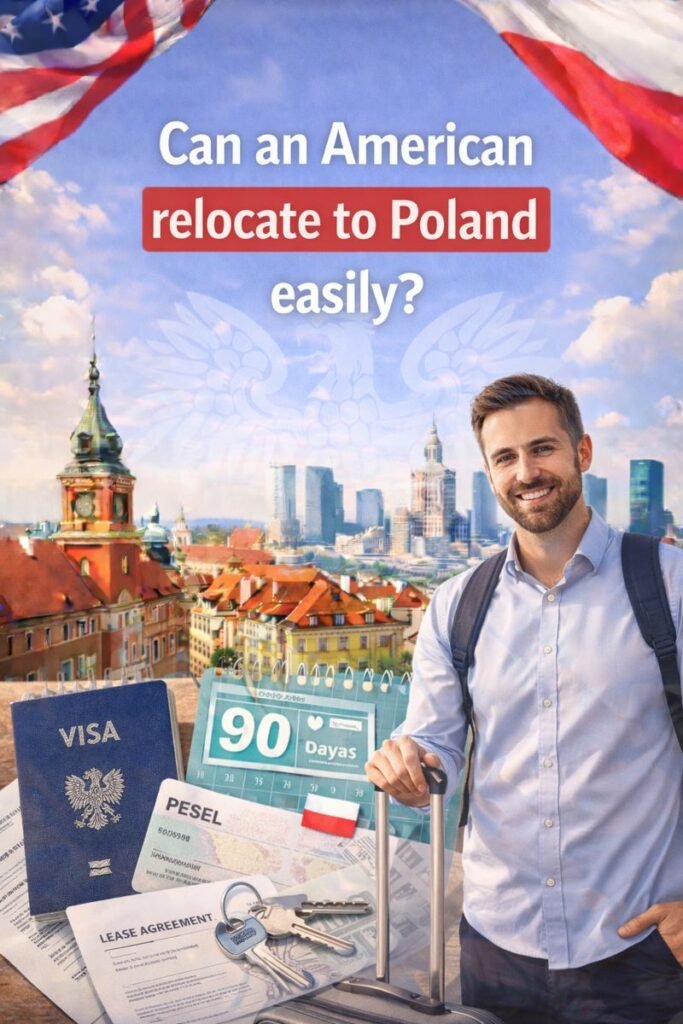
Can an American relocate to Poland easily? Yes — but it depends on your “entry lane.” For Americans, Poland can feel surprisingly manageable if you arrive with a clear legal basis (work, study, family, business) and a realistic plan for housing, paperwork, and healthcare. It becomes much harder if you want to “just move and figure it out” after arriving on a short stay, because the 90/180-day Schengen limit and residence-permit timelines create pressure fast.
Poland is popular with Americans because it’s EU-based, relatively affordable compared to many Western capitals, and has strong job markets in major cities. But “easy” is only true when you treat relocation like a checklist project, not a spontaneous move.
Short Answer
Yes, an American can relocate to Poland relatively easily — if you have a valid long-stay plan. The smoothest relocations usually happen when you:
- enter Poland visa-free for short stay only to scout, then return to apply properly if needed, or
- arrive with the right long-stay visa/residence pathway already lined up (job offer, university admission, spouse/family link, etc.).
Who can do it easily
- Americans with an employer willing to sponsor the right paperwork (or a job offer in an international company).
- Americans accepted into a Polish university program.
- Americans relocating for family reasons (spouse/partner routes are often clearer than “I just want to live there”).
Who will face limitations
- Americans trying to relocate with no job, no studies, and no family basis, expecting to stay long-term anyway (that’s where it stops being “easy”).
Legal & Practical Requirements
1) Know your “clock”: 90 days in any 180 days (Schengen)
Americans can travel to Poland for tourism/business without a visa for up to 90 days in a 180-day period within the Schengen area. Your passport validity rules also matter (U.S. travel guidance strongly recommends 6 months validity and notes the Schengen rule of at least 3 months beyond intended departure).
Why this matters: If you arrive “to see how it goes,” you may run out of time before you can set up housing, a stable legal stay, and the paperwork needed for longer residence.
2) For long stays, you’ll need either a D visa or a residence permit pathway
Poland’s consular guidance for a D-type national visa shows the core requirements and the process through the e-Konsulat system (application registered online, printed, signed, passport requirements, etc.).
For temporary residence permits, Poland supports applicants through the official MOS portal (Moduł Obsługi Spraw), which helps you prepare applications, avoid mistakes, and in some cases submit.
3) You’ll want PESEL sooner than you think
PESEL is a Polish personal identification number used across everyday life (admin, healthcare registration, many services). Official guidance states you’ll get PESEL automatically if you register your residence (meldunek) for over 30 days, or you can apply for PESEL at a municipality office if you can’t register but you need it.
Translation into relocation reality: your lease + address registration can unlock PESEL faster, and PESEL unlocks smoother admin.
Step-by-Step: How an American Can Relocate to Poland Easily
Step 1: Pick your relocation lane (this decides everything)
Before you book a one-way flight, choose the lane that fits your life:
- Work (employer, contract, planned stay)
- Study (admission + student stay basis)
- Family (partner/spouse/Polish family ties)
- Business (real operation and compliance plan)
- Short-stay scout first (visit 2–6 weeks, then decide)
The mistake is trying to live long-term while using only the short-stay rules.
Step 2: Do a 2-week “paperwork prep sprint” while still in the U.S.
This is what makes relocation feel easy later:
- Make sure your passport validity won’t be an issue for Schengen travel timing.
- Collect digital + printed copies of:
- passport
- birth certificate (optional but helpful)
- proof of savings/income
- health insurance documents
- marriage certificate (if family route)
- diplomas/employment letters (if work route)
- If you expect to use U.S. documents officially, plan for professional translations later (Polish offices often expect Polish-language documents).
Step 3: Decide where to land first (your “starter city”)
If your goal is “easy,” start in a city with international employers, expat services, and English-friendly infrastructure. Warsaw is the obvious default, but other large cities can also work depending on your job or budget.
Step 4: Secure a temporary base for 2–6 weeks
Even if you plan a long-term lease, start with:
- short-term rental / serviced apartment
- flexible cancellation
- a location near transit and admin offices
This gives you breathing room to:
- view apartments
- compare neighborhoods
- avoid signing a bad contract under time pressure
Step 5: Get a long-term lease (and ask about address registration)
For many Americans, housing is the first “hard part,” because landlords vary widely. When you sign, ask if the landlord will support address registration (meldunek). Once you register residence for over 30 days, the government notes you’ll get PESEL automatically; otherwise you can apply separately if you can’t register but need PESEL.
Practical tip: If you can get a landlord who cooperates with registration, your admin life becomes dramatically smoother.
Step 6: Use the MOS portal to reduce residence-permit mistakes
If you’re applying for a residence permit, use Poland’s official MOS portal, created by the Office for Foreigners (Poland), to prepare forms and avoid common errors.
This isn’t a “hack,” it’s the government’s own tool meant to reduce rejections and back-and-forth.
Step 7: If you need a D visa, follow the consular workflow exactly
If you’re applying from abroad, Poland’s consular page for the U.S. outlines the D visa workflow and requirements (e-Konsulat registration, printed/signed form, passport criteria).
Relocation pro move: match your documents to your story:
- your lease dates
- your job/study start dates
- your insurance coverage dates
Misalignment creates delays.
Step 8: Build your “daily life system” in the first month
Your first month should focus on:
- PESEL (via registration or direct application)
- stable banking/payment method
- healthcare plan (public vs private arrangements depend on your status and work/study setup)
- mobile number + basic admin readiness
Costs & Fees (What Americans Usually Pay)
Relocation costs vary wildly by city and lifestyle, but Americans usually spend in these buckets:
Upfront relocation costs
- Flights
- 1–2 months of temporary housing (often the biggest “hidden cost”)
- Deposit + first rent month for a long-term lease
- Basic setup: SIM card, transit pass, furniture basics (if renting unfurnished)
Paperwork and compliance costs
- D-visa application costs can include consular fees (vary by location and category; follow the consular page requirements carefully).
- Certified translations (common if you’re using U.S. documents in official contexts)
Monthly living costs
- Rent + utilities + building/admin fees (common structure in Poland)
- Transportation
- Healthcare (public access depends on status; many expats also budget for private visits)
Reality check: If you want “easy,” budget a cushion. Most “hard relocations” are really “underfunded relocations.”
Common Problems & Mistakes Americans Make
1) Confusing “I can enter” with “I can live here”
Yes, Americans can stay short-term under Schengen rules—but long-term life needs a long-term basis.
2) Waiting too long to plan the long-stay path
If you arrive without a plan and then start researching, you burn your 90 days fast—especially in winter when housing searches slow down.
3) Signing a lease without understanding what it enables
A lease can be more than housing: it can help with address registration, which can help with PESEL (or reduce friction).
4) Ignoring the “systems” (not just the vibe)
Many Americans pick a neighborhood based on Instagram and only later realize:
- commute is brutal
- admin offices are far
- landlord won’t help with basic paperwork
5) Not using official tools
The MOS portal exists specifically to help foreigners prepare correct applications and avoid mistakes. People who skip it often end up doing extra loops.
Living in Poland as an American — What Changes in Daily Life
Money
Poland can feel more “bank transfer + paperwork” than the U.S. Keep receipts, confirmations, and scan everything.
Healthcare
How you access healthcare depends on your status (work/study/family) and insurance setup. Many expats use a mixed approach (public coverage where eligible + private visits for speed).
Housing
Expect:
- deposits
- contracts in Polish (often)
- different norms on furnishing and utilities
Work culture
International companies may operate in English; local offices often run in Polish. Even without Polish, many Americans do well if they choose the right employer environment.
Quality of life
Poland can feel highly livable once you solve:
- legal stay plan
- stable housing
- PESEL/admin readiness
Is It Worth It for Americans?
Worth it if you:
- have a real long-term basis (work/study/family/business)
- can fund the first 2–3 months without stress
- are okay with paperwork-heavy processes
Reconsider if you:
- want a long-term move but refuse admin steps
- have no clear purpose or income plan
- expect a “no paperwork” European lifestyle
Pros
- Large cities are increasingly international.
- Practical, modern infrastructure in many areas.
- Strong “value for money” compared to some Western capitals.
Cons
- Bureaucracy can feel intense if you’re unprepared.
- Polish language can be a barrier in official settings.
Alternatives & Related Options
If “easy relocation” is your top priority, consider these options:
- Scout-first strategy: spend 2–6 weeks in Poland within the 90-day window to choose a city/neighborhood and line up paperwork, then apply properly if needed.
- Start with study (clear structure and timeline, often a smoother admin path)
- Start with work (employer structure reduces chaos)
- Try another EU country where you already have stronger ties (job offer, family, language)
FAQ (MANDATORY – US INTENT)
Can Americans do this without speaking Polish?
Yes, especially in major cities. But to keep it “easy,” you’ll want: a translator option for contracts/appointments, and at least basic survival Polish.
Is it easy for US citizens?
It can be—if you have a clear legal lane and don’t rely on short-stay rules to build a long-term life.
How long does it take?
A “smooth” relocation timeline often looks like:
- 2–4 weeks: housing + basics
- 1–3 months: deeper admin setup and residence steps (varies by your category and workload)
Using the MOS portal can reduce mistakes and delays in residence applications.
How much money do you need?
Enough for:
- move-in costs (temporary housing + deposit + first rent)
- a safety buffer for paperwork, translations, and surprises
Underfunded relocations are the #1 reason “easy” turns into “stressful.”
Is Poland stricter than other EU countries?
Poland is fairly typical: documentation-heavy, rule-based. The main difference is how fast the 90-day clock forces decisions if you arrive without a plan.
Conclusion
Can an American relocate to Poland easily? Yes—when you relocate with a plan: pick a legal lane (work/study/family/business), secure housing in stages, get PESEL/admin readiness early, and use official tools like the MOS portal to keep applications clean. If you try to “move first, decide later” under Schengen short-stay rules, relocation stops being easy very quickly.